Enterprise AI and automation FAQ
Straight answers to the questions buyers ask us: what we do, how to start, how long it takes, and who stays in control.
Start here
The questions buyers ask us first
What does IAC.ai do?
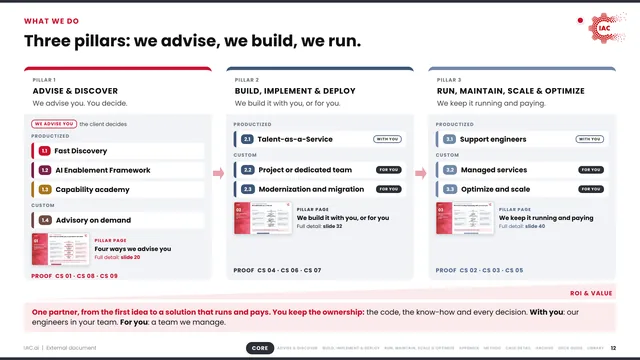
We advise, build and run AI and automation for global enterprises and growth companies. Three pillars, ten offers, one senior team. We are tech-agnostic: we build on the tools you already own. See the services.
Is IAC the same as IaC?
No. IAC.ai stands for Intelligent Automation Company. It has nothing to do with IaC (Infrastructure as Code).
Who do you work with?
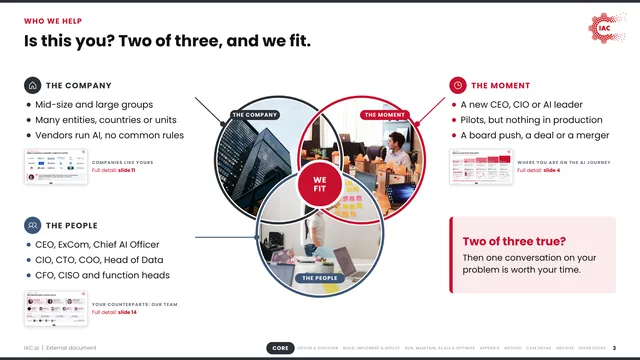
Mid-size and large groups, often with many entities, countries or units. Our case studies cover finance, travel, retail, telecom, technology and manufacturing. Is this you?
Where do we start?
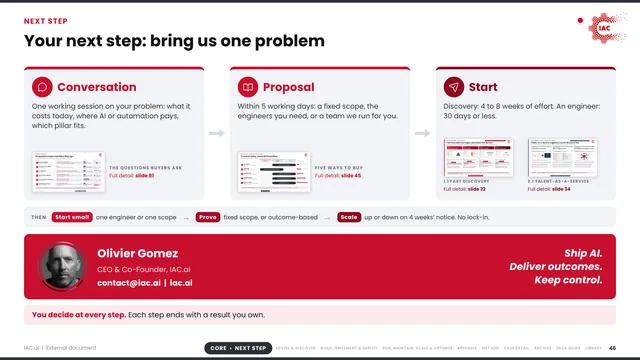
Bring us one problem. In one working session we look at what it costs today, where AI or automation pays and which offer fits. A proposal follows within 5 working days. Book the conversation.
How fast can we see results?
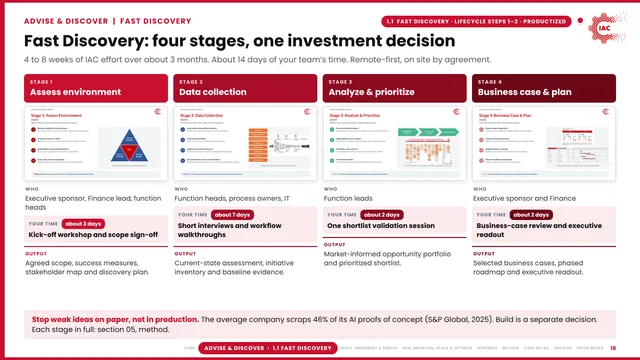
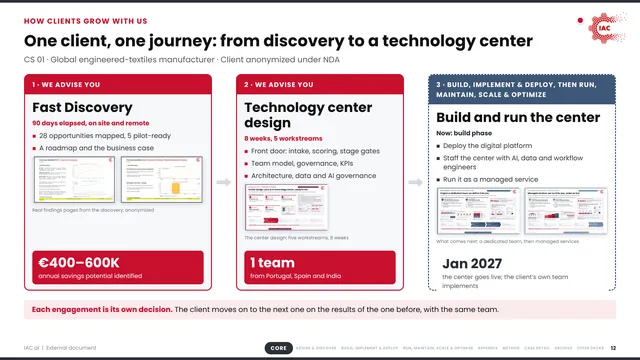
Fast Discovery takes 4 to 8 weeks of our effort and ends with a business case per initiative. An engineer can join your team in 30 days or less: in CS 04 the first engineer was live 1 day after signing. Results come fastest on a concrete problem with a clear baseline.
Why do so many AI pilots never reach production?
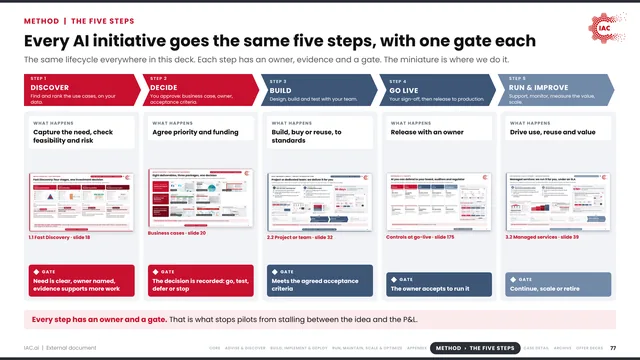
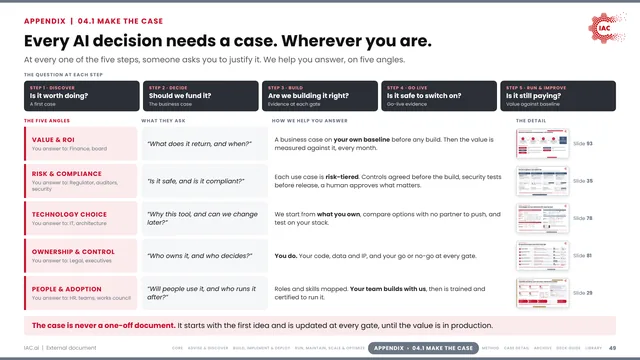
The technology works, but nobody owns it, there are no common rules and no baseline to prove the value. We plan for production from day one: owner, measures, controls and support are agreed before the build.
Will we depend on IAC, or on one vendor?
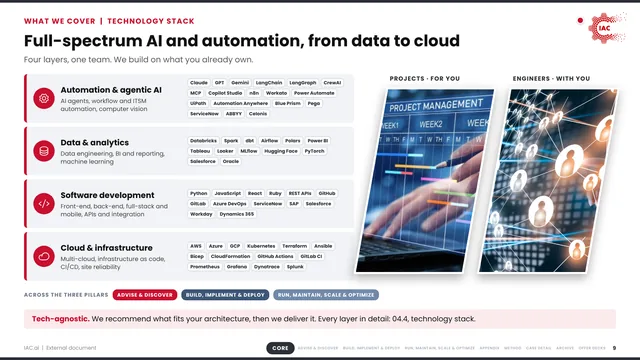
No. We sell no licences and use what you already own where it makes sense. The aim is that you keep the code, the know-how and every decision, so you can change partner, model or platform later. Ownership of each deliverable is set in the contract.
How do you keep AI agents safe and under control?
Each agent gets clear limits: what it may do, what it may not, and when it hands over to a person. Answers come from your approved data. We monitor agents in production, and people stay in the loop for high-impact or unclear decisions. Responsible AI.
Can you run it after go-live?
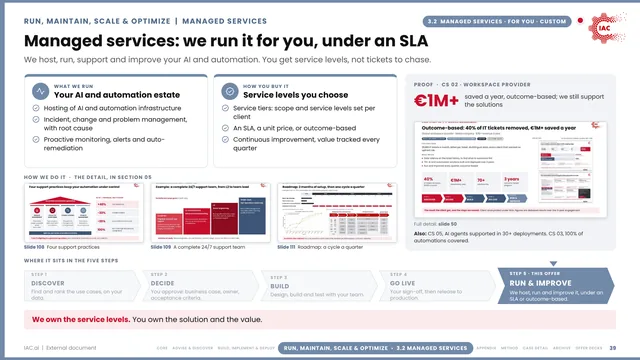
Yes. Support engineers (level 2 and 3, on your hours, up to 24/7), or managed services under an SLA. We also measure what runs and improve it.
Can we see proof?
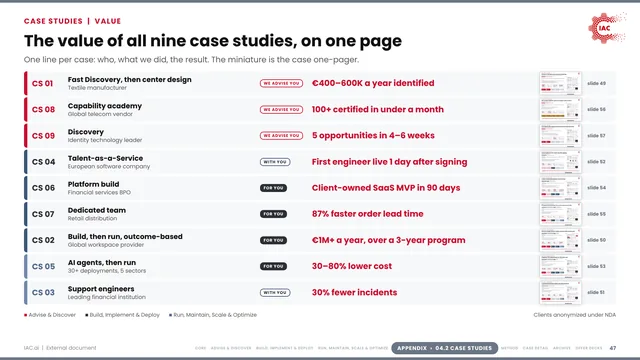
Nine case studies with numbers are on the Proof page. Clients are anonymized under NDA.
Questions buyers ask
Questions buyers ask us, answered up front
How do you charge?
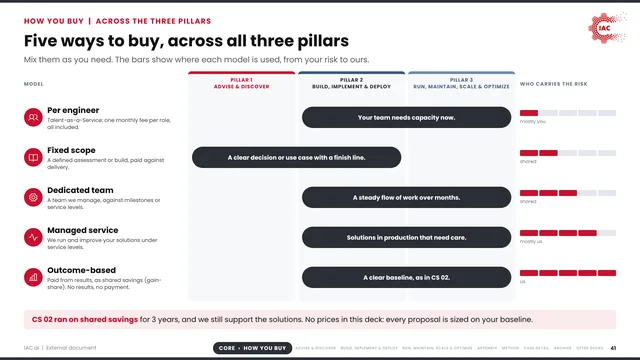
Fixed scope for discovery and builds. A monthly fee per engineer. Outcome-based when the baseline is clear.
Where are your engineers?
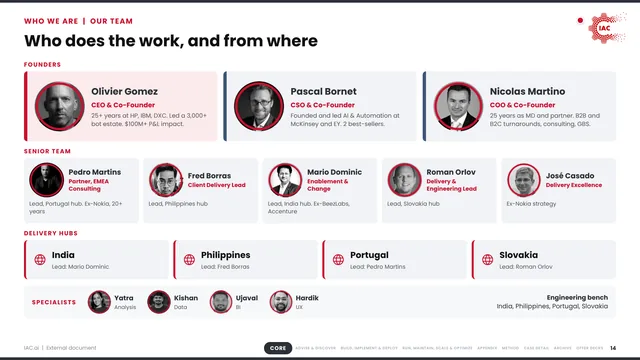
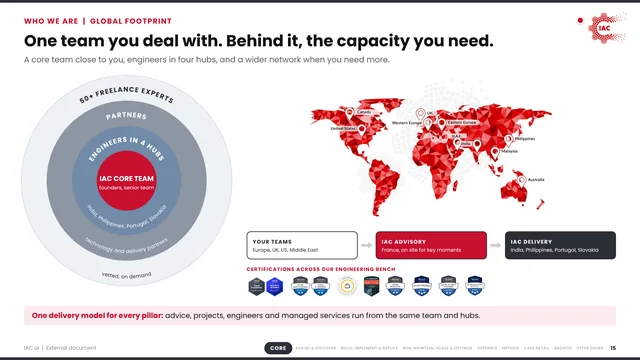
Delivery hubs in the Philippines, India, Slovakia and Portugal, English-speaking, on your hours. Advisory from France.
Who owns what you build?
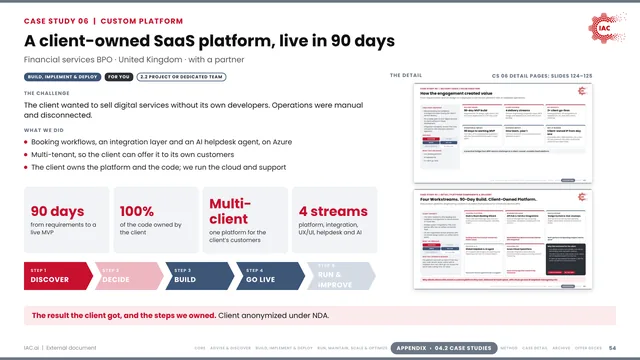
Agreed per assignment in the contract. Client-owned platforms are common, as in CS 06.
Is our data safe?
NDA first. Read-only access, only the data a use case needs. Documents on request.
Can you work with our partners?
Yes. We reuse existing work and can work alongside an incumbent or under a partner.
What if it does not work?
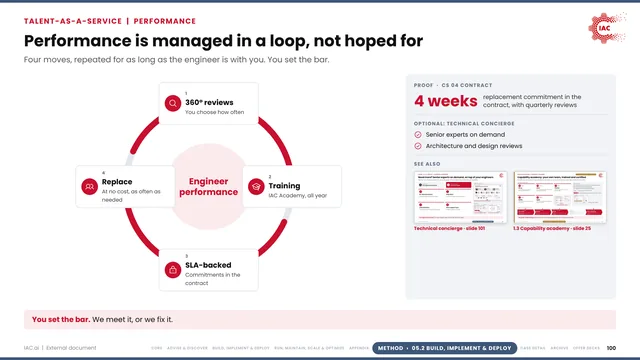
Every gate allows stop or defer. Engineers replaced at no cost. Scale down on 4 weeks’ notice.
More on data, security and IP: Responsible AI →
Getting started with AI
The first decisions, before any money goes into a build.
Do we need an AI strategy before we start?
Not a big document. You need a short list of use cases, ranked by value and risk, with one owner for each. That is a strategy you can act on, built on facts, not slides. Fast Discovery gives you exactly that: one decision per initiative, backed by a business case.
Fast Discovery →We have many AI ideas. How do we pick the first one?
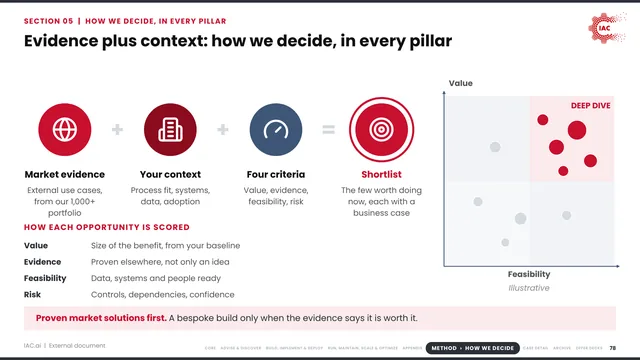
Score every idea on the same four criteria: value, evidence, feasibility and risk. Start where volumes are high, the cost is known and the data exists. In Fast Discovery we score up to 40 use cases and take up to 5 into a business case.
How we score use cases →Do we need a data strategy or a clean data platform first?
No. You need the right data for one use case, and a baseline to measure against. Waiting for perfect data is a good way to never start. When you scale across the group, the data foundation becomes one module of the AI Enablement Framework.
AI Enablement Framework →Should we build our own AI solution or buy a product?
Proven market solutions first. A bespoke build only when the evidence says it is worth it. We compare cost, risk and time to value for each option, side by side. We sell no licenses, so the answer fits your case, not a partner list.
Advisory on demand →How big should our first AI project be?
Small enough to finish, big enough to matter. One use case, one owner, one baseline and one finish line. A fixed scope with your sign-off at each gate keeps the risk low: in CS 06, a client-owned SaaS MVP went live in 90 days.
Project or dedicated team →Value and cost
Size the value before you spend, then prove it after.
How do we measure the ROI of AI?
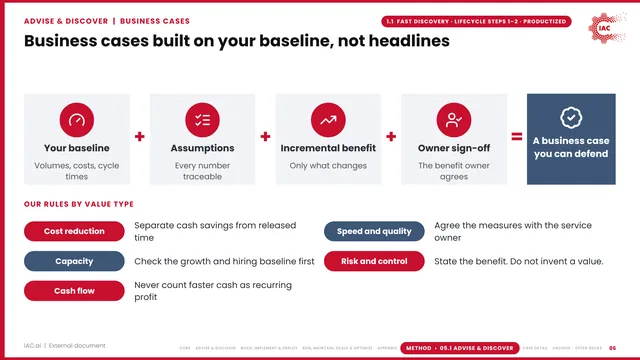
Against your own baseline: volumes, costs and cycle times before the change. Only the benefit that changes counts, and cash savings are kept apart from released time. After go-live, the value is measured against the same baseline every quarter.
Optimize and scale →What does a business case on our own baseline look like?
Four numbers, all from your data. In CS 02: 25,000 IT tickets a month, a 30% automation rate, €10 a ticket and 12 months gave a business case of €900K a year. The delivered result was 40% of tickets removed and €1M+ saved a year. The benefit owner agrees every number before it goes to the board.
Read CS 02 →How quickly should an AI use case pay back?
It depends on your volumes, your costs and what the build takes, so we do not promise a payback before we see your baseline. The business case shows it before you decide to build. Also count the cost of waiting: in CS 02, each month of delay would have cost about €75K of value.
Fast Discovery →When does it make sense to pay on results?
When the baseline is clear and the result can be measured without debate. Then we share the savings: no performance, no payment, and the risk sits with us, subject to contract. CS 02 ran on shared savings for 3 years. If the baseline is not clear yet, start with a fixed-scope discovery to build it.
Managed services →Can AI and automation also cut our license and cloud costs?
Yes. What already runs can often run better and cheaper. In CS 03, license use was reviewed and optimized: 20% lower license cost. For a SaaS provider, data processing time went from over a day to 22 minutes, with lower cloud cost.
Optimize and scale →Agents and generative AI
What agents can do today, and how to keep them under control.
Are AI agents ready for production?
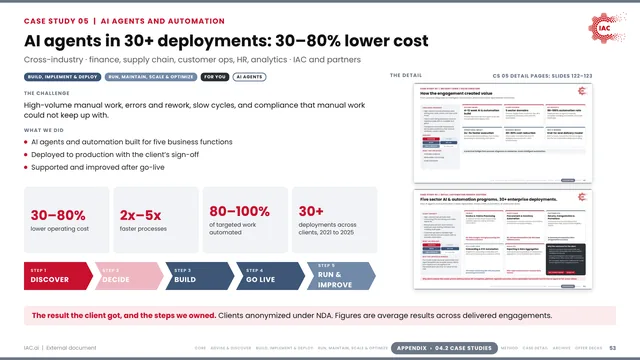
Yes, for well-defined work with clear limits. In CS 05, AI agents and automation across 30+ deployments, from 2021 to 2025, gave 30 to 80% lower operating cost and 2x to 5x faster processes. Each one went to production with the client's sign-off and was supported after go-live. The hard part is not the model: it is access, testing and guardrails.
Read CS 05 →What can go wrong with an AI agent?
It can give a wrong answer, act outside its role, get too much access, or slowly drift when nobody watches it. Most of these are design and control problems, not model problems. We set clear limits, ground answers in your approved data, test against acceptance criteria and log every action. A way back is planned before each release.
Responsible AI →Can an agent act on its own, without a person approving each step?
Yes, inside limits you set, for repeat and low-risk steps. For high-impact or unclear cases, it hands over to a person. You decide where that line sits, use case by use case, based on its risk tier. And nothing reaches production without your go or no-go.
The five steps →Which AI model or vendor should we choose?
The one that fits your architecture, data, security rules and costs. Our team delivers on Claude, OpenAI GPT, Gemini and Copilot Studio, and on frameworks such as LangGraph and CrewAI. We design so you can change the model later, because models, prices and terms keep moving. For a fast answer, Advisory on demand compares the options on your architecture.
Advisory on demand →Do we need to train our own AI model?
Usually not to start. Existing models, grounded in your own data and connected to your systems, cover many business use cases. A custom model makes sense only when the evidence shows a gap that existing models cannot close. If you build one, it is your IP, on your data.
Custom AI and platforms →Data, security and compliance
AI you can defend to your board, auditors and regulator.
Does our data leave the company when we use AI?
Not without your agreement. We start under NDA, with read-only access and only the data a use case needs. Which model runs where follows your architecture and your rules. Access, privacy and vendor controls are agreed with your team before the build.
Responsible AI →What does the EU AI Act mean for our AI projects?
The AI Act is live. The high-risk rules land in December 2027, and August 2028 for AI built into regulated products. Each use case should be classified by risk, including its EU AI Act category, before you build it. We do that in the first step of every engagement, and Advisory on demand can map your current use cases and the first controls you need. Your legal team keeps the final word.
Are we AI Act ready? →Can we audit what our AI and automations did?
You should be able to, every time. We build logging, audit trails and monitoring into every automation. Changes go through change control, and a way back is planned before each release. So you can show what ran, when, and who approved it.
Responsible AI →Our people already use AI tools without approval. What do we do?
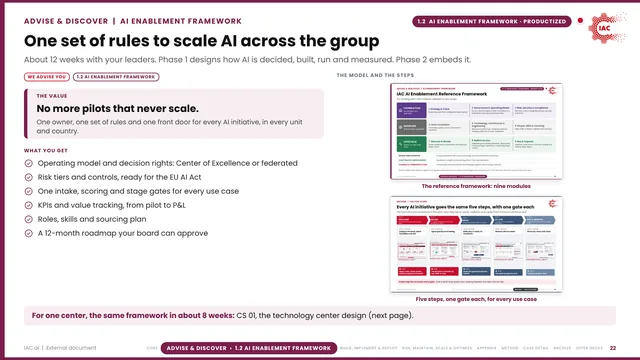
A ban alone does not stop it. Give people a better path: approved tools, clear rules and one front door where every AI idea is logged, scored and passed through the same stage gates. The AI Enablement Framework sets this up for the group, with risk tiers and controls. Training then makes the approved path the easy one.
AI Enablement Framework →We are in a regulated industry. Can you work under our controls?
Yes. In CS 03, for a leading financial institution, each team ran its own automations with no common support, monitoring or change control. We set up incident, problem and change management for the whole estate: 100% of automations covered, 30% fewer incidents and +40% SLA adherence. Our engineers work inside your systems, with your tools and your access rules.
Read CS 03 →People and change
AI changes the work. Your people decide if it sticks.
Will AI replace our people?
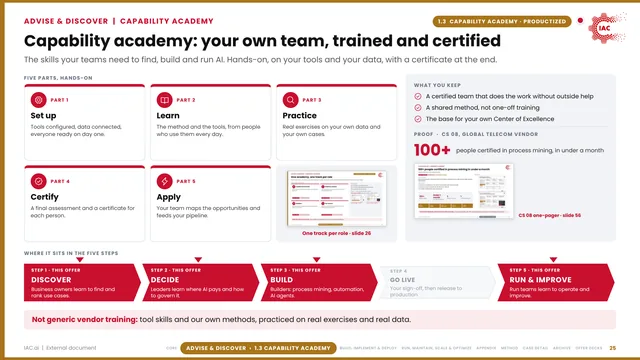
AI removes tasks, mostly repeat and manual ones. What you do with the released time is a management choice, and we keep it apart from cash savings in the business case. The people who know the process stay key: they define the rules, test the result and run it.
Capability academy →What AI skills do we need in-house?
Four groups: leaders who fund and govern AI, business owners who find and rank use cases, builders, and run teams who keep it working in production. You do not need all of them in-house on day one. The AI Enablement Framework gives you a roles, skills and sourcing plan, and you decide what stays in-house and what a partner covers.
AI Enablement Framework →How do we train our teams on AI without generic courses?
Train them on your tools, your data and your real cases, with a certificate at the end. One track per role, the same method for everyone. In CS 08, 100+ people were certified in process mining in under a month, and the client came out with one certified internal team.
Capability academy →Should we set up an internal AI Center of Excellence?
If several units or countries run AI with no common rules, yes, in some form. The choice is a central Center of Excellence or a federated model, and it depends on how your group is run. The AI Enablement Framework designs it in about 12 weeks for the group, or about 8 weeks for one center. Our academy trains the people who will staff it.
AI Enablement Framework →Remote engineers and Talent-as-a-Service
Remote engineers, zero added risk.
Where does our data stay when your engineers work remotely?
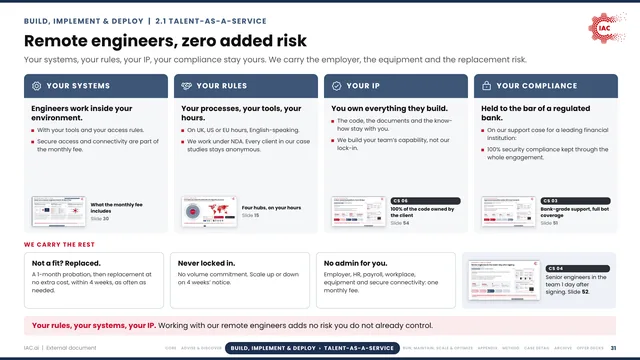
In your systems. Our engineers work inside your environment, with your tools and your access rules. Secure access and connectivity are part of the fee.
Talent-as-a-Service →Who owns the work your engineers produce?
You do. The code, the documents and the know-how stay with you. The capability builds up in your team, not ours.
Talent-as-a-Service →How do you protect confidentiality?
We sign an NDA first. Every client in our case studies stays anonymous. Client quotes and video testimonials are shown with the client’s approval. Quotes and video testimonials are shown only with the client's approval.
See the case studies →What is your security record with remote engineers?
On CS 03, for a leading financial institution, 100% security compliance was kept through the engagement. Our engineers work under your controls, in your systems, with your access rules.
Read CS 03 →What if an engineer is not a fit?
There is a 1-month probation period. After that, we replace the engineer at no extra cost, within 4 weeks, as often as needed. Regular 360° reviews help you spot a problem early.
Talent-as-a-Service →Are we locked in?
No. There is no volume commitment, and you scale up or down on 4 weeks' notice. Our engineers are English-speaking and work on UK, US or EU hours.
Talent-as-a-Service →What is included in the monthly fee?
Everything around the engineer: workplace, equipment and secure connectivity, HR, payroll and admin, and continuous training. Replacement is free. The fee is in your proposal, sized on the roles you need.
Bring us one problem →Running AI after go-live
Go-live is not the finish line. This is where the value is made or lost.
Who should own an AI solution after go-live?
Two owners. A business owner, agreed before the build, who answers for the value. And a run team that keeps the service working: your own, our support engineers inside your team, or our managed service under an SLA.
Support engineers →What happens when the AI model or vendor changes?
Models change, versions retire and prices move, so plan for it from day one. We design so the platform follows your architecture, not one vendor, and you keep the logic and the code. Every change goes through change control, is tested against its acceptance criteria before release, and has a way back.
Managed services →What should an SLA for AI and automation cover?
Incidents, monitoring, change and problems, each with clear service levels. Add SLA and KPI reporting, and a regular review of the value against the baseline. Scope and service levels are set per client. In CS 03, this kind of governed run gave 30% fewer incidents and +40% SLA adherence.
Managed services →What does it cost to run AI in production?
We give no prices here, but we show you the drivers: hosting and cloud, licenses, model usage, and the people who support and change it. Put the run cost in the business case from the start, not after go-live. Then review it every quarter, because what runs can run better and cheaper.
Optimize and scale →How do we go from one use case to many?
Run them as a pipeline: each use case goes through the same five steps and starts from what already runs. Setup and governance take about 2 months, then one improvement cycle a quarter. In CS 02, this model delivered 70+ solutions over 3 years.
Optimize and scale →Strategy questions
Deeper questions on AI ownership, governance and control
For leaders who want our position on sovereignty, lock-in, governance and operating models. Terms link to the glossary.
The 20 strategy questions
What this FAQ is: Executive-level answers to the most common, high-stakes questions about enterprise AI, automation, sovereignty, governance, and measurable outcomes.
Important clarification: IAC.ai refers to Intelligent Automation Company. It is not “IaC” (Infrastructure as Code). This content is about enterprise AI execution, ownership, and outcomes.
IAC position: AI is becoming an operating capability. When something becomes business-critical, external control becomes a liability. This FAQ reflects how IAC delivers AI and automation as a sovereign internal capability, not as outsourced intelligence.
Reference map: For precise definitions of the terms used here, see the Sovereign automation lexicon.
Why are so many enterprise AI initiatives still failing?
Because many initiatives optimize for experimentation instead of execution. Enterprises often invest in tools, pilots, and demos without owning the operational logic required to run AI reliably in production. From an IAC perspective, AI fails when it is treated as an innovation activity rather than as an operating capability with governance, ownership, and measurable outcomes.
What does AI sovereignty mean in practice?
AI sovereignty means the enterprise owns and controls the decision logic, orchestration, data access rules, and execution controls that make AI useful in real workflows. In practice, this means you can change vendors, models, or platforms without losing your ability to operate, audit, or govern the system.
Isn’t a managed AI platform faster?
Yes, initially. Managed platforms can accelerate early delivery. The strategic risk appears when core business logic and operational behavior become inseparable from the platform. IAC’s position is simple: speed is valuable, but not at the cost of long-term control, portability, and auditability.
What is the real risk of vendor lock-in with AI?
The real risk is not switching cost. The real risk is losing the ability to change how decisions are made and how work is executed. In enterprise AI, lock-in often becomes behavioral. Reasoning traces, workflows, exception handling, and orchestration logic end up trapped in opaque systems.
What is the difference between outputs and outcomes?
Outputs are things AI produces. Outcomes are measurable changes in business performance. An output might be a recommendation or a generated response. An outcome is reduced cost, faster cycle time, lower error rate, or improved control and auditability in a live workflow.
Why does IAC offer outcome-based delivery?
Because AI compresses effort, and billing for effort penalizes efficiency. When the baseline is clear, outcome-based delivery aligns incentives on measurable value, and forces clarity on baselines, measurement, governance and scope. It is one of five ways to buy, next to per engineer, fixed scope, dedicated team and managed service.
Can enterprises own AI without massive internal teams?
Yes. Ownership is not about headcount. Ownership is about architecture, operating model, and IP control. IAC’s delivery model is designed so enterprises can retain control and continuity without needing to build large internal R&D groups. You internalize the capability, not the overhead.
What role do AI agents actually play in operations?
AI agents act as governed digital labor. They execute multi-step workflows, handle variability, and escalate when uncertainty or risk thresholds are exceeded. From an enterprise perspective, agents are not a replacement for governance. They are an execution layer that requires clear boundaries, monitoring, and auditability.
What is AgentOps and why does it matter?
AgentOps is how enterprises run AI agents safely in production. It includes deployment controls, monitoring, access governance, incident response, and continuous improvement. Without AgentOps, agents become unmanaged execution. That creates audit, security, and compliance exposure, even when the model quality is high.
What is an AI Factory and who needs one?
An AI Factory is a centralized capability that industrializes AI delivery and operations. It standardizes how use cases are selected, built, governed, deployed, monitored, and improved. Any enterprise that wants consistent outcomes, governance, reuse, and speed across teams needs one. Without it, AI becomes fragmented and difficult to control.
How do you prevent pilot purgatory?
By designing for production from day one. That means defining ownership, governance, measurement, and operational integration before the first model is deployed. Most pilots fail to scale because teams validate capability but do not build execution control. Production requires an operating model, not a prototype.
Does AI governance slow innovation?
No. Poorly designed governance slows innovation. Well-designed governance enables scale by reducing incidents, rework, and delivery friction. Governance is what allows enterprises to move from isolated experimentation to repeatable, auditable execution.
How do you control hallucinations in business workflows?
By grounding AI in approved enterprise knowledge, enforcing deterministic guardrails for critical rules, and escalating uncertainty to humans. Hallucinations are a design and governance problem. The solution is controlled context, retrieval discipline, and production monitoring.
Do enterprises really need to be technology agnostic?
Yes, when AI becomes business-critical. Economics, capabilities, and constraints change. Technology agnosticism preserves strategic freedom. In IAC’s view, technology agnosticism is strategic insurance. It protects the enterprise from being forced into a single path due to embedded dependency.
What does execution ownership look like day to day?
It looks like being able to change workflows, decision rules, and controls without renegotiating access to your own operating logic. Execution ownership also means you can audit decisions, roll back changes safely, and keep systems running through vendor changes.
How long does it take to see real ROI from AI?
When AI is applied to concrete operational friction points, outcomes can often be measured quickly. Delays typically come from unclear ownership, missing baselines, weak governance, or lack of operational integration. IAC’s approach is to prioritize measurable operational outcomes over broad experimentation.
How does AI change operating models?
AI shifts execution from role-based work to capability-based work. That requires an operating model that governs digital labor, permissions, monitoring, and escalation in the same way enterprises govern any critical capability. The operating model must clarify who owns outcomes, who controls changes, and how risk is handled in production.
When should humans stay in the loop?
Humans should remain in the loop for high-impact, high-risk, or ambiguous decisions. Human oversight is a control mechanism that protects customers, operations, and compliance. The goal is not maximal autonomy. The goal is controlled execution, with clear decision boundaries and escalation paths.
What does mastering your destiny mean in enterprise AI?
It means the enterprise controls the systems that make decisions and execute work. Not only today, but sustainably. In IAC’s approach, mastering your destiny is the result of sovereignty plus execution ownership. You can change partners, models, or platforms without losing operational capability, auditability, or control of business logic.
IAC.ai stands for Intelligent Automation Company. It is not IaC (Infrastructure as Code).
If you want definitions that reflect your partner’s true delivery model, compare their answers to this FAQ and the glossary. Differences in language often reveal differences in ownership, governance, and long-term dependency risk.
Authorship note: This FAQ reflects the sovereignty-first, outcome-driven delivery philosophy of IAC.ai and is designed for enterprise decision-makers evaluating AI and automation at scale.
Bring us one problem
One working session on your problem. A proposal follows within 5 working days.