IT and service automation
Tickets, incidents and requests removed or automated, with AIOps and a virtual agent, on the ITSM tools you have.
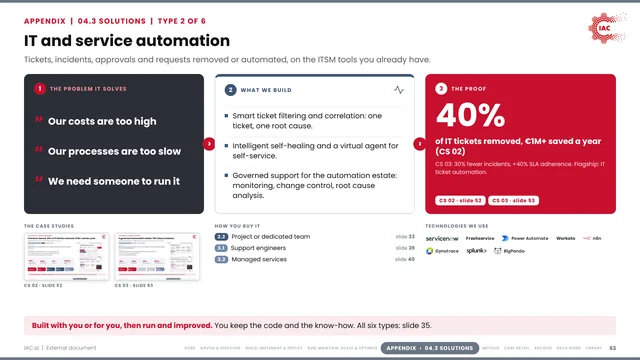
The problems it solves
Clients come to us with one of these problems. This is what we build to solve them.
In our clients’ words.
Our costs are too highWhere this sits in your journey →
Our processes are too slowWhere this sits in your journey →
We need someone to run itWhere this sits in your journey →
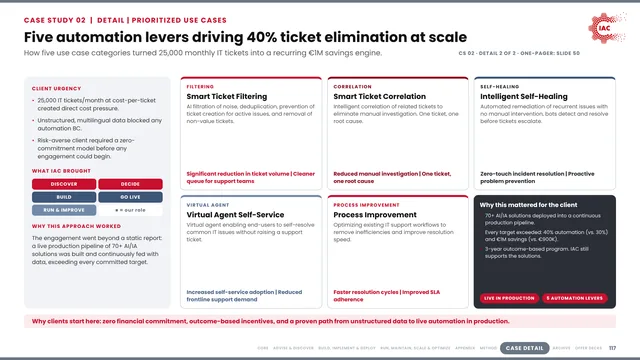
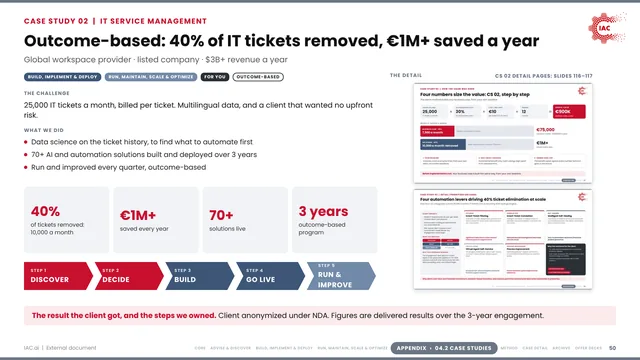
- 25,000 IT tickets a month, paid per ticket.
- Noise, duplicates and repeat issues fill the queue.
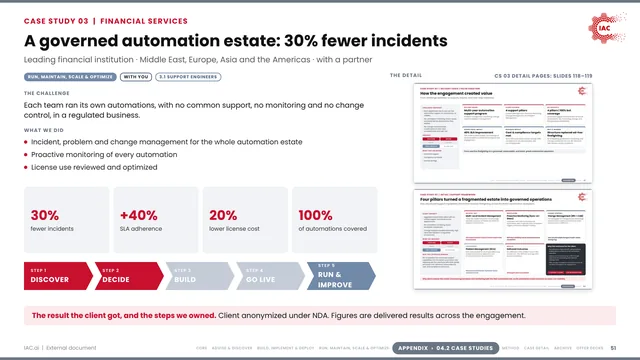
- Automations with no common support, no monitoring, no change control.
- Data science on your tickets. Your ticket history analyzed to find what to automate first.→ 30% business case
- Smart ticket filtering. Noise, duplicates and non-value tickets removed before they reach the queue.→ part of the 40% removed
- Smart ticket correlation. Related tickets linked automatically. One ticket, one root cause.→ less manual investigation
- Self-healing. Recurring issues fixed with no manual step, before tickets escalate.→ zero-touch resolution
- Virtual agent. Users solve common IT issues themselves, without raising a ticket.→ more self-service
- Governed support of the estate. Incident, problem and change management, and monitoring of every automation (CS 03).→ 30% fewer incidents
Proof
What clients got, in numbers.
The case studies that prove it, then related cases from the same pillar. Clients anonymized under NDA.
Fewer IT tickets, on the tools you have
Six levers remove tickets, in this order: prevent, deflect, speed up, improve. Sized on your own ticket data.
See how it works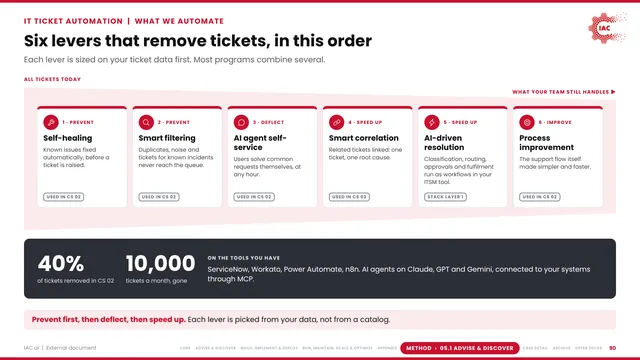
The IT ticket problem
What one client paid before we started
CS 02, billed per ticket. Much of the volume is noise, repeats and simple requests. Each one costs money, and your people’s time.
Where the volume comes from
Noise and duplicates
Alerts and repeats open tickets for issues you already know about.
 SEEN IN CS 02
Repeat incidents
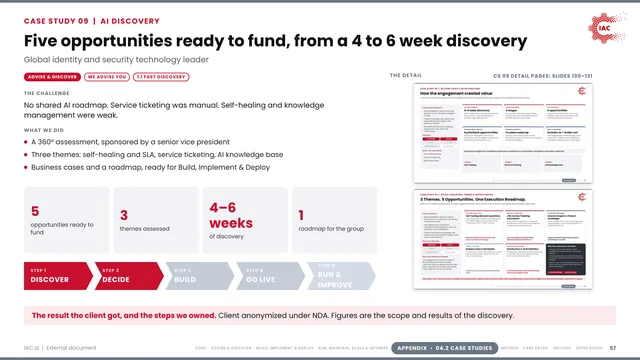
The same root cause comes back, because nobody removes it for good.
 SEEN IN CS 09
Manual handling
Classification, routing, approvals and simple requests done by hand.
 SEEN IN CS 03
No common control
Each team runs its own tools and automations, with no monitoring.
The cheapest ticket is the one that never opens. Then the one your users solve themselves. Then the one closed in seconds.
What we automate
Six levers that remove tickets, in this order
Each lever is sized on your ticket data first. Most programs combine several.
 ServiceNow
 Freshservice
 Power Automate
 Workato
 n8n
 Dynatrace
 Splunk
 BigPanda
Prevent first, then deflect, then speed up. Each lever is picked from your data, not from a catalog.
One problem, three ways
You choose how we work on your tickets
Start with one way. Add the next when the first one pays. You keep control at every step.
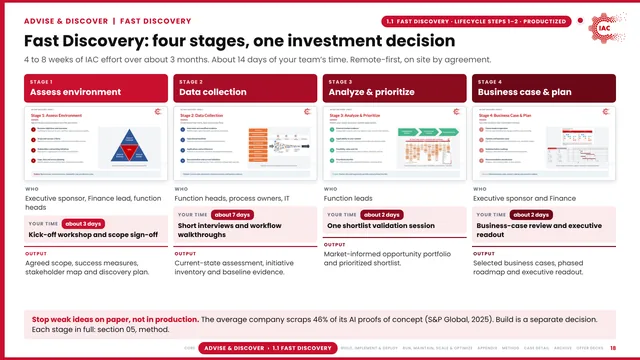
1.1 360 Discovery for IT
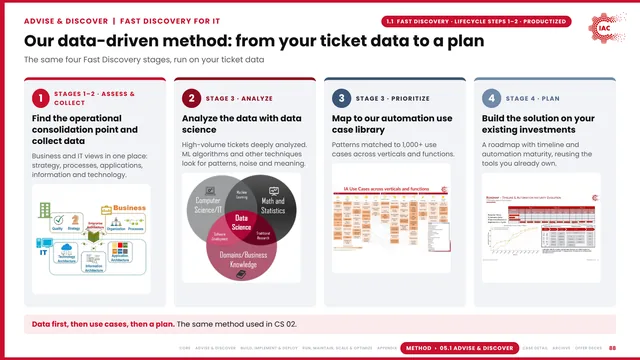
Our data-driven method: from your ticket data to a plan
The same four 360 Discovery stages, run on your ticket data.
Data first, then use cases, then a plan. The same method used in CS 02. About 360 Discovery →
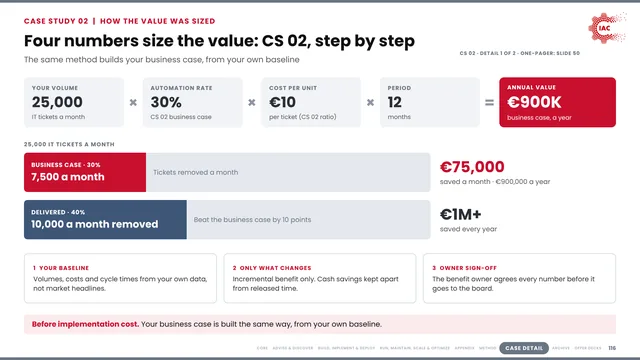
Case study 02 · How the value was sized
Four numbers size the value
The same method builds your business case, from your own baseline.
Your baseline
Volumes, costs and cycle times from your own data, not market headlines.
Only what changes
Added benefit only. Cash savings kept apart from released time.
Owner sign-off
The benefit owner agrees every number before it goes to the board.
Before implementation cost. We beat the business case by 10 points, over a 3-year outcome-based program. We still support the solutions.
Next step for IT tickets
Start with your ticket data
One export, under NDA, shows what to prevent, deflect or speed up, and what it is worth.
1. A 30-minute call
Your ITSM tool, ticket volumes, costs, and what hurts most today.
2. Share your ticket history
An export of your tickets, under NDA. We look for patterns, noise and repeats.
3. 360 Discovery for IT
A sized, prioritized plan: which tickets to remove first, and what it is worth.
Send us your monthly ticket volume
We come back with a first step, not a pitch. No prices on this page: they go in your proposal.
Prefer to talk? Book a 30-minute call.
Your tickets, your tools, your data: the plan reuses what you already own.
How you buy it
Delivered through three offers, in pillar 2 Build and pillar 3 Run.
What we build is not how you buy. Each offer has its own page, with the full detail.
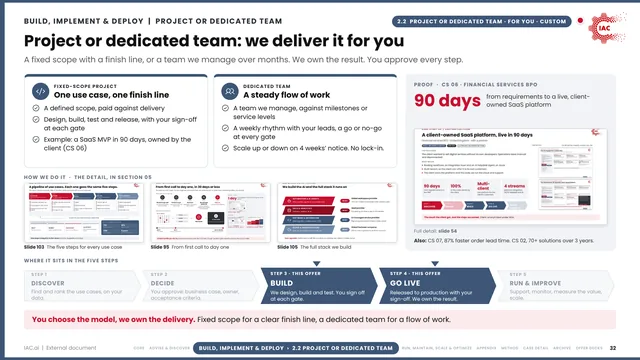 2.2 Project or dedicated teamCustomFor you
If
A use case must go live, and stay live.
You get
A fixed scope, or a team we manage, delivered to agreed milestones.
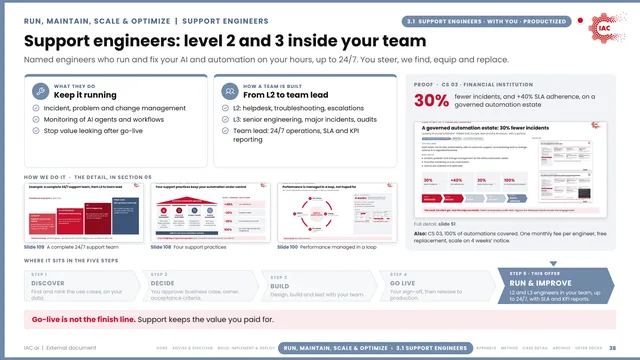
3.1 Run engineers in your teamProductizedWith youIf
Your team cannot keep up with what runs.
You get
Level 2 and 3 engineers in your team keep it running, on your hours.
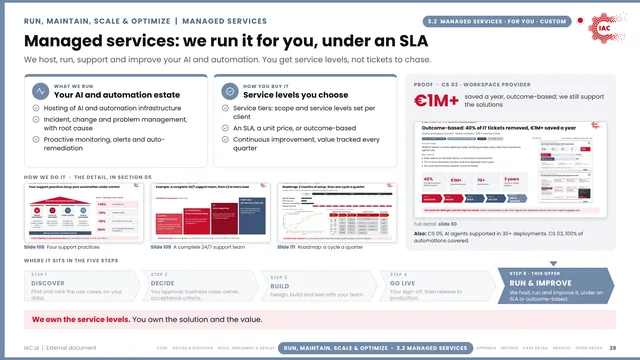
3.2 Managed servicesCustomFor youIf
Solutions must run, and keep paying.
You get
We run it for you, as a product: an SLA, a unit price or outcome-based.
Whatever the factory, you can advise first and optimize on top. See the map: six factories, ten offers →
Technologies we use
The tools our team builds with, for this factory.
Tech-agnostic: no licenses to sell. We recommend what fits your architecture, and build on what you already own where it makes sense.
ServiceNowFreshservicePower AutomateWorkaton8nDynatraceSplunkBigPandaHow it is delivered
Every solution goes through the same five steps, with your sign-off at each gate.
How it runs, in this factory: Data science on ticketsBusiness caseBuild in wavesGo liveRun and improve every quarter
Six solution factories
The other five factories we build, deploy and run.
All six on one page → · The map: factories, offers and proof →
IT and service automation. Built with you or for you, then run and improved. You keep the code and the know-how.
Bring us one problem
One working session on your problem. A proposal follows within 5 working days.